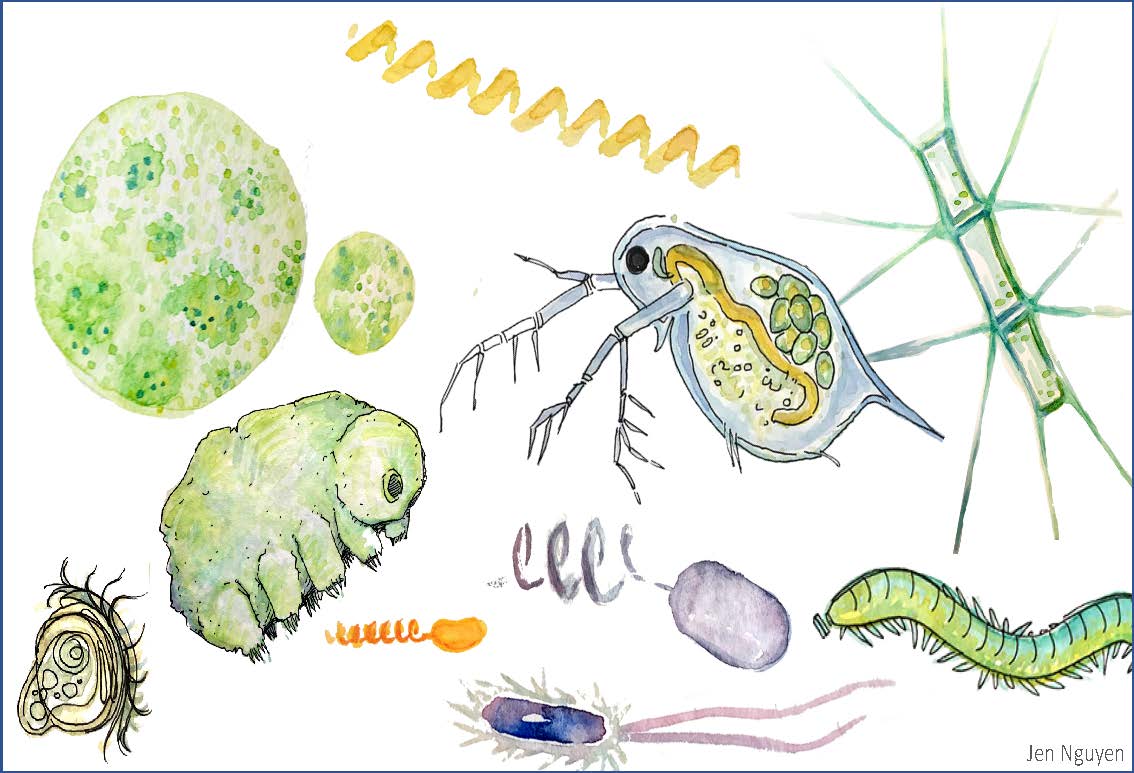
Microorganisms live in a world almost unimaginable to humans – if a bacterium were enlarged to be the size of a human, a human enlarged by the same degree could stretch between Zürich and London. At such tiny scales, the fundamental rules of life change, and in this workshop, we’ll explore how microorganisms move, feed, and interact with their environment and each other.
Despite their small size, microorganisms have enormous impacts in the world. Microbiomes, or groups of microorganisms, populate all environments: from the human body, to plant roots and soil, to pollutants in the ocean. The microorganisms that make up these microbiomes are incredibly diverse and are crucial to sustaining life everywhere on our planet. Some microorganisms are even used as tiny living factories, grown in large numbers to produce many of the “synthetic” products we use in our daily lives.
In this workshop, we will combine direct microscopic visualization of environmental microbiomes with synthetic replicas and models, in a hands-on exploration of life at these invisible scales.
Microorganisms live in a world almost unimaginable to humans – if a bacterium were enlarged to be the size of a human, a human enlarged by the same degree could stretch between Zürich and London. At such tiny scales, the fundamental rules of life change, and in this workshop, we’ll explore how microorganisms move, feed, and interact with their environment and each other.
Despite their small size, microorganisms have enormous impacts in the world. Microbiomes, or groups of microorganisms, populate all environments: from the human body, to plant roots and soil, to pollutants in the ocean. The microorganisms that make up these microbiomes are incredibly diverse and are crucial to sustaining life everywhere on our planet. Some microorganisms are even used as tiny living factories, grown in large numbers to produce many of the “synthetic” products we use in our daily lives.
In this workshop, we will combine direct microscopic visualization of environmental microbiomes with synthetic replicas and models, in a hands-on exploration of life at these invisible scales.
Microorganisms live in a world almost unimaginable to humans – if a bacterium were enlarged to be the size of a human, a human enlarged by the same degree could stretch between Zürich and London. At such tiny scales, the fundamental rules of life change, and in this workshop, we’ll explore how microorganisms move, feed, and interact with their environment and each other.
Despite their small size, microorganisms have enormous impacts in the world. Microbiomes, or groups of microorganisms, populate all environments: from the human body, to plant roots and soil, to pollutants in the ocean. The microorganisms that make up these microbiomes are incredibly diverse and are crucial to sustaining life everywhere on our planet. Some microorganisms are even used as tiny living factories, grown in large numbers to produce many of the “synthetic” products we use in our daily lives.
In this workshop, we will combine direct microscopic visualization of environmental microbiomes with synthetic replicas and models, in a hands-on exploration of life at these invisible scales.
Microorganisms live in a world almost unimaginable to humans – if a bacterium were enlarged to be the size of a human, a human enlarged by the same degree could stretch between Zürich and London. At such tiny scales, the fundamental rules of life change, and in this workshop, we’ll explore how microorganisms move, feed, and interact with their environment and each other.
Despite their small size, microorganisms have enormous impacts in the world. Microbiomes, or groups of microorganisms, populate all environments: from the human body, to plant roots and soil, to pollutants in the ocean. The microorganisms that make up these microbiomes are incredibly diverse and are crucial to sustaining life everywhere on our planet. Some microorganisms are even used as tiny living factories, grown in large numbers to produce many of the “synthetic” products we use in our daily lives.
In this workshop, we will combine direct microscopic visualization of environmental microbiomes with synthetic replicas and models, in a hands-on exploration of life at these invisible scales.
Microorganisms live in a world almost unimaginable to humans – if a bacterium were enlarged to be the size of a human, a human enlarged by the same degree could stretch between Zürich and London. At such tiny scales, the fundamental rules of life change, and in this workshop, we’ll explore how microorganisms move, feed, and interact with their environment and each other.
Despite their small size, microorganisms have enormous impacts in the world. Microbiomes, or groups of microorganisms, populate all environments: from the human body, to plant roots and soil, to pollutants in the ocean. The microorganisms that make up these microbiomes are incredibly diverse and are crucial to sustaining life everywhere on our planet. Some microorganisms are even used as tiny living factories, grown in large numbers to produce many of the “synthetic” products we use in our daily lives.
In this workshop, we will combine direct microscopic visualization of environmental microbiomes with synthetic replicas and models, in a hands-on exploration of life at these invisible scales.